How to Buy Comments on Facebook Safely and Easily
Facebook posts can receive plenty of impressions without generating much visible conversation.
For creators, businesses, advertisers, and page owners, an empty comment section can make otherwise useful content appear less active.
That is why some marketers search for how to buy comments on facebook as a way to create initial engagement around selected posts.
Buying comments, however, should never be treated as a replacement for good content or genuine community interaction.
The quality of the comments, the accounts behind them, their relevance, delivery pattern, and the provider you choose can all affect how natural the engagement appears.
This guide explains the buying process, available comment types, costs, risks, and the factors worth checking before placing an order.
Can You Buy Comments on Facebook?
Yes, third-party social media marketing providers offer Facebook comment services for public posts, videos, Reels, advertisements, and other eligible content.
Depending on the provider, buyers may be able to select the number of comments, language, comment style, or even supply the exact text they want posted.
People who buy Facebook comments usually have different objectives. A business may want a product announcement to appear more active, while a creator may want initial discussion around a new video.
An advertiser may be more interested in supporting an ad's existing conversation.
Current service pages appearing in search results commonly distinguish between random comments and custom comments, while other differentiators include targeting, delivery speed, account quality, refill terms, and the ability to control the submitted text.
The important question, therefore, is not simply whether comments are available for purchase. Buyers need to understand what they are actually ordering before choosing a package.
How to Buy Comments on Facebook Step by Step
The exact dashboard will differ between providers, but the basic purchasing process is usually straightforward.
Before ordering anything, make sure the Facebook content is publicly accessible so that the service can reach the correct post.
1. Choose a Suitable Facebook Comment Service
Start by comparing available Facebook engagement services rather than immediately selecting the cheapest package.
Look at whether the service provides:
- Random or general comments
- Custom-written comments
- Language-specific comments
- Comments from higher-quality profiles
- Comment replies
- Post, video, Reel, or ad support
- Gradual or controlled delivery
- Clear cancellation or refill information
The service description matters because two packages offering the same number of comments can deliver very different results.
2. Decide What Type of Comments You Need
Your next decision should be based on the actual purpose of the Facebook post.
For a general entertainment post, simple relevant reactions may be enough. A product post, local business promotion, campaign announcement, or educational post may benefit more from carefully prepared comments that match the subject.
Buyers looking to buy custom Facebook comments usually want more control over the conversation. Instead of receiving generic phrases, they can submit text related to the product, question, video, topic, or campaign.
That distinction becomes especially important when the comments will be visible to potential customers.
3. Copy the Correct Facebook Post URL
Open the specific Facebook post and copy its public URL.
Do not automatically submit your Page homepage or profile address when the service specifically asks for a post URL.
The provider needs to know exactly where the ordered comments should appear.
Check the URL once before completing the order. A small mistake at this stage can send engagement to the wrong content or cause the order to fail.
4. Select a Realistic Quantity
A post with almost no activity may not need hundreds of comments immediately.
Start with a quantity that makes sense in relation to the Page size, normal reach, existing likes, shares, views, and previous engagement.
The goal should be to avoid a comment pattern that looks disconnected from every other visible metric.
For example, 300 comments on a post with only a handful of views can look unusual to human visitors even before platform systems are considered.
5. Add Custom Comment Text When Available
Custom comments provide greater control, but the wording needs attention.
Avoid submitting twenty versions of nearly the same sentence. Comments such as “Amazing,” “Amazing post,” “Very amazing,” and “This is amazing” can quickly create an artificial pattern.
Instead, vary sentence length, vocabulary, intent, and perspective where appropriate.
A product post, for example, could naturally receive comments involving product features, availability, sizing, price, delivery, customer questions, or general reactions.
6. Check the Order Details Before Payment
Review the service name, quantity, link, estimated delivery information, and any instructions before paying.
You should also confirm whether the provider requires only the public post link. Be particularly cautious about a service requesting your Facebook password for a normal engagement order.
Several current buying guides similarly identify password requests and unclear delivery information as warning signs.
Once everything matches your intended order, you can proceed to payment.
7. Monitor Delivery and the Comment Section
Do not consider the process finished immediately after placing the order.
Watch how comments arrive, whether they remain relevant, whether duplicate phrases appear, and whether genuine users begin interacting with them.
If real people ask questions, respond naturally rather than leaving the conversation unattended.
This is where purchased engagement and genuine community management should become clearly separated.
Why TechSMM Is a Good Choice for Buying Facebook Comments
TechSMM can be a practical choice for users who want to buy Facebook comments through a simple and organized SMM panel.
The platform brings different Facebook engagement services into one dashboard, which makes it easier for creators, businesses, marketers, and resellers to manage their campaigns without switching between multiple providers.
One reason to choose TechSMM is the variety of Facebook services available alongside comments.
Users can manage comments together with other engagement options such as likes, followers, reactions, shares, and views when their campaign requires a broader strategy.
This makes the platform suitable for both individual promotions and ongoing social media marketing work.
TechSMM also focuses on an easy ordering process. Users can select a suitable Facebook service, provide the required public link, choose the quantity, and place an order directly through the dashboard.
Different service options allow buyers to select a package according to their campaign needs and budget.
Another advantage is that TechSMM is designed for different types of customers, including agencies and resellers who may handle multiple orders regularly.
For users searching for a convenient platform to buy Facebook comments, TechSMM offers a centralized way to manage Facebook engagement while keeping the ordering process straightforward and flexible.
Which Facebook Comment Type Should You Choose?
Different posts create different types of conversations. Choosing a comment service by quantity alone can therefore produce poor results.
The following comparison makes the differences easier to understand.
| Comment Type | Best Used For | Main Advantage | Main Consideration |
|---|---|---|---|
| Random comments | General posts and simple content | Easy to order | May be less context-specific |
| Custom comments | Products, brands, campaigns | Greater control over wording | Requires good comment preparation |
| Comment replies | Existing discussions | Supports conversation threads | Must make sense in context |
| Reel comments | Short-form video | Adds visible interaction | Comments should match video content |
| Ad comments | Sponsored content | Can support an active discussion area | Commercial claims require extra care |
| Language-targeted comments | Regional audiences | Better audience alignment | Availability varies by provider |
The table also explains why the cheapest option is not always the most suitable. Matching the service to the content is usually more important than maximizing the raw comment count.
Real vs Fake Facebook Comments
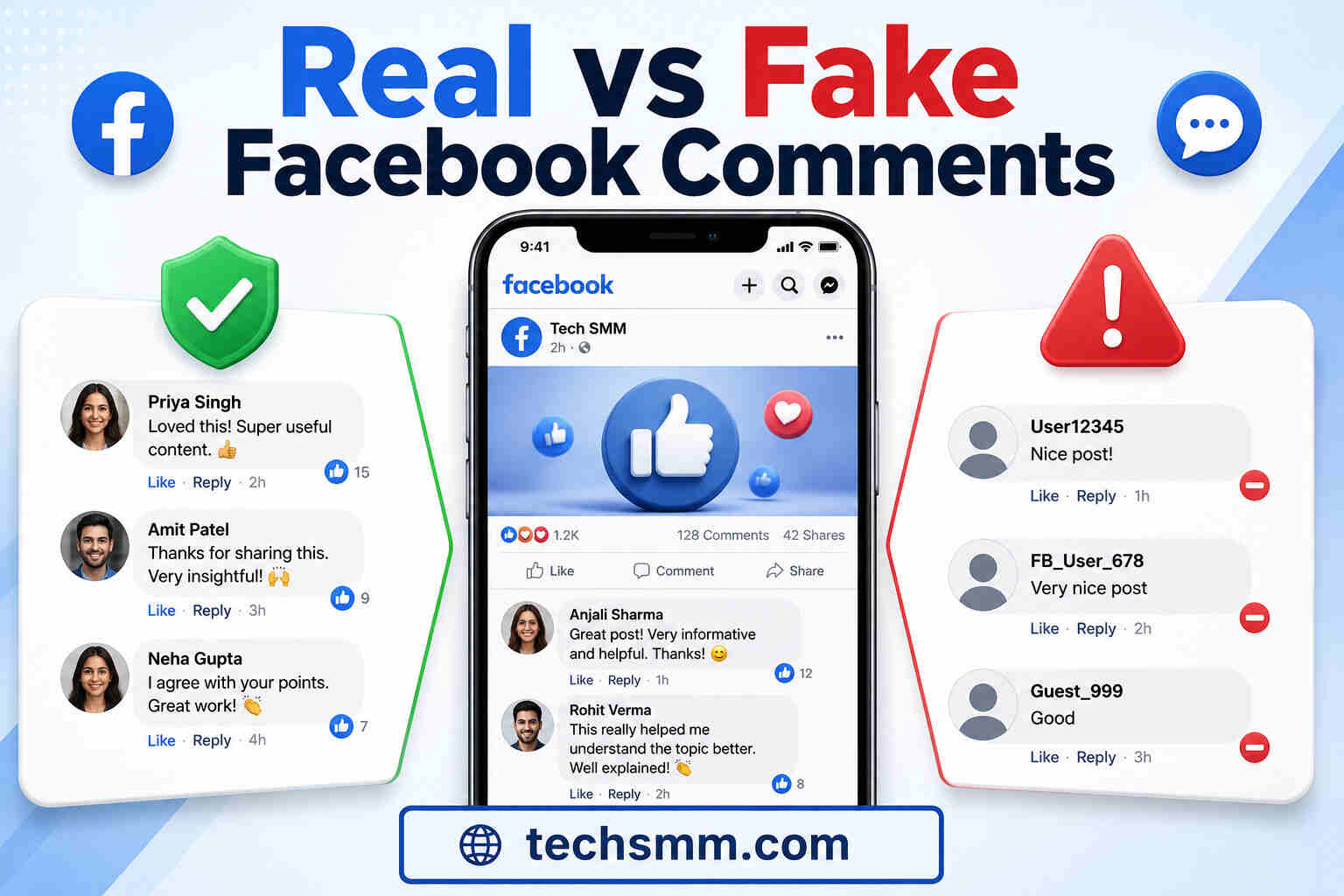
The phrase “real comments” is often used loosely by social media service providers, so buyers should examine what a seller actually means by it.
When people search for buy real Facebook comments, they are usually looking for engagement from established-looking accounts rather than obvious empty, automated, or low-quality profiles.
But a profile appearing realistic does not automatically mean that the comment represents a genuine unsolicited opinion.
That distinction matters.
Meta's Community Standards specifically address inauthentic behavior and state that people should not use fake accounts or artificially boost popularity in prohibited ways.
For the buyer, real vs fake Facebook comments should therefore involve more than profile appearance.
Consider relevance, authenticity of the interaction, account quality, repetitive patterns, and whether comments misrepresent genuine customer experiences.
If the comments are being used around products or services, the distinction becomes even more important because commercial endorsements and reviews can involve additional legal obligations.
When Do Custom Facebook Comments Make More Sense?
Random comments can add visible activity, but they do not fit every type of post.
Custom comments become more useful when context matters. A clothing store may want questions about sizes or colors, while a software company may want discussion related to product features.
A creator might prefer comments connected directly to the topic covered in a video.
Someone planning to buy Facebook post comments should therefore examine the content before choosing a service.
Useful custom comments generally have three characteristics: they make sense without additional explanation, they relate to something actually visible in the post, and they do not create false factual claims about a product or experience.
This approach makes the next consideration—commercial content and advertisements—particularly important.
Should You Buy Facebook Comments for Ads?
Advertisements require greater caution than ordinary entertainment posts because people may use the comment section when making purchasing decisions.
Businesses considering whether to buy Facebook comments for ads should avoid comments that falsely claim personal experience, guaranteed results, purchases that never occurred, or other fabricated endorsements.
In the United States, for example, the FTC's Consumer Reviews and Testimonials Rule addresses fake or false consumer reviews and testimonials.
Its guidance also covers sellers or brokers of fake reviews under specific circumstances.
A general conversation starter is therefore very different from manufacturing false customer experiences.
For advertising, long-term credibility matters more than making the comment number as large as possible.
Can You Buy Facebook Comments for Reels?
Facebook Reels can also receive comments, although service availability varies among providers.
Users searching to buy Facebook comments for Reels are generally trying to add visible interaction to short-form video content. Because Reels are highly visual, comments should ideally relate to something viewers can actually see or understand from the video.
A cooking Reel might naturally generate questions about ingredients. A travel clip could receive discussion about the location. A tutorial may generate questions about a step shown in the video.
Generic promotional phrases repeated underneath unrelated Reels can have the opposite effect and make the engagement appear less credible.
If the objective also includes broader engagement beyond comments, some marketers combine different signals rather than concentrating everything into a single metric.
For example, the process used to purchase Facebook shares involves a different engagement action and should be evaluated separately rather than assuming comments and shares serve identical purposes.
What Are Facebook Comment Replies?
A comment and a comment reply are related but not identical.
A standard comment begins a new conversation underneath a post. A reply appears underneath an existing comment and continues that particular thread.
Businesses sometimes buy Facebook comment replies when an existing conversation needs additional interaction.
However, replies require more contextual accuracy than standalone comments.
If the original comment asks, “Is this available in black?” a completely unrelated reply will immediately look unnatural. The response needs to make sense when somebody reads the entire thread.
This makes comment replies better suited to carefully planned discussion rather than bulk generic engagement.
How Much Does It Cost to Buy Facebook Comments?
There is no universal Facebook comment price.
The cost varies according to the provider, number of comments, profile quality, location or language targeting, customization, delivery method, and whether additional features are included.
Current service listings illustrate this variation. Some providers price small packages at only a few dollars, while custom or targeted options may be priced separately or at a premium.
Rather than asking only how much does it cost to buy Facebook comments, compare what is included in the price.
A useful evaluation can look like this:
Total value = comment relevance + account quality + delivery control + support + retention − unnecessary risk
The cheapest package may offer good value in some situations, but price alone cannot tell you whether the comments will fit your content.
What Should You Check Before Buying Facebook Comments?
A buyer usually wants three things simultaneously: affordability, visible quality, and low risk. Those goals are easier to balance when the provider is evaluated systematically.
Start by checking the service description. It should explain what kind of comments are delivered rather than relying only on words such as “best,” “premium,” or “real.”
Then examine whether the provider clearly states:
- What information is required
- Which Facebook content is supported
- Whether custom comments are available
- Approximate delivery expectations
- What happens if an order cannot be completed
- Whether support is available
- Whether refill or replacement conditions exist
- Whether language or geographic options are available
Marketers should also understand that paid social media services and organic optimization are not exactly the same practice.
The difference between SMM and SMO becomes useful when deciding which activities are intended to create immediate visibility and which are meant to improve broader organic presence.
Once a provider passes the basic checks, the next step is deciding how to make the purchased activity fit naturally with the rest of the Page.
How to Make Facebook Comment Activity Look More Natural
Natural Facebook engagement is rarely made up of one identical action.
Real audiences react differently. Some users like a post without commenting, some write questions, some reply to other people, and others simply watch the content.
For that reason, do not view purchased comments as an isolated number that has to become as large as possible.
A healthier content approach includes strong posts, genuine audience replies, reactions, community management, videos, shares, and regular publishing. Paid engagement—where used—should remain secondary to the Page's actual content strategy.
Profile credibility can matter as well. Some established businesses also investigate identity signals such as Facebook blue tick verification, but verification and engagement are separate concepts and one should not be presented as proof of the other.
Ultimately, visitors judge the complete Page, not only the number beside the comment icon.
Is It Safe to Buy Facebook Comments?
There is no accurate universal promise that purchasing comments is completely risk-free.
Meta states that it restricts forms of inauthentic behavior, including artificial boosting of popularity, and its spam policies address deceptive behavior designed to manipulate engagement.
Therefore, anyone asking is it safe to buy Facebook comments should consider both platform risk and reputation risk.
Platform risk relates to Facebook's rules and enforcement systems.
Reputation risk is simpler: if visitors notice obviously irrelevant, repetitive, or misleading comments, trust in the Page can decline regardless of whether Facebook takes any action.
Avoid services that depend on fake identities, compromised accounts, misleading endorsements, or other deceptive activity.
Never assume that a provider calling its service “safe” means Meta has approved that service.
Is Buying Facebook Comments Legal?
The legal question depends on the jurisdiction and, importantly, what the comments actually communicate.
Simply purchasing a marketing service should not be confused with a universal legal guarantee covering every possible use of that service.
Fake testimonials, deceptive endorsements, fabricated reviews, and false commercial claims can be regulated.
For example, the U.S. Federal Trade Commission's final Consumer Reviews and Testimonials Rule prohibits specified fake or false reviews and testimonials and certain purchases of fake indicators of social media influence when the applicable conditions are met.
Consequently, the answer to is buying Facebook comments legal cannot responsibly be reduced to a global yes or no.
Businesses should avoid representing purchased comments as genuine customer experiences when they are not. Companies operating in regulated industries or using comments as commercial testimonials should obtain advice relevant to their own jurisdiction and circumstances.
Common Mistakes to Avoid When Buying Facebook Comments
Most poor outcomes are not caused by the number of comments alone. Problems often begin when buyers prioritize quantity while ignoring context.
One mistake is ordering a very large package for a post with almost no other activity. Another is filling the comment section with repetitive praise that does not mention anything related to the content.
Using fake customer stories is considerably more serious. A comment saying “I love this video” is fundamentally different from a fabricated statement claiming that someone purchased a product, received a specific result, or had a customer experience that never occurred.
Buyers should also avoid:
- Giving unnecessary account credentials
- Ordering before checking the post URL
- Using identical custom comments
- Ignoring genuine customer questions
- Making unsupported product claims
- Choosing packages based only on price
- Assuming paid comments guarantee organic reach
- Treating engagement numbers as a substitute for content quality
Avoiding these mistakes makes it easier to evaluate whether the service actually contributes anything useful to the post.
A Simple Facebook Comment Buying Checklist
Before placing an order, use a short decision check.
Ask yourself whether the post is public, whether the comments will be relevant, whether the quantity makes sense, and whether the provider clearly explains its service.
Then check the most important buyer factors:
| Question | What to Look For |
|---|---|
| Is the service clearly described? | Comment source/type, quantity and eligibility |
| Can comments match the post? | Custom or relevant options |
| Is a password required? | Normally avoid unnecessary login requests |
| Is delivery explained? | Reasonable start and completion expectations |
| Are commercial claims involved? | Avoid deceptive testimonials or fake experiences |
| Does the quantity look realistic? | Keep it proportional to other activity |
| Is support available? | Clear contact or order-support process |
If several answers are unclear, investigate before paying rather than relying on the provider's marketing claims.
Final Words
Understanding how to buy comments on facebook involves more than selecting a quantity and entering a post URL.
A better decision considers the type of comments, relevance to the content, account quality, delivery pattern, price, provider transparency, platform rules, and whether the engagement could mislead real visitors.
Purchased comments may create visible activity, but they should not replace useful content, genuine audience relationships, or honest customer conversations.
Use any paid engagement carefully, keep commercial claims truthful, and judge success by the overall quality of the Page rather than the comment count alone.
Frequently Asked Questions
Can you buy comments on Facebook?
Yes. Third-party marketing providers offer comment packages for eligible public Facebook posts and, depending on the service, videos, ads, and Reels. Buyers may be able to choose quantities, custom wording, languages, or other options. Facebook itself does not sell these third-party comment packages, so service quality and risk can vary.
What information do I need to buy Facebook comments?
Most standard services need the public URL of the Facebook post and the number or type of comments required. Custom-comment services may also ask you to provide the exact comment text. Be cautious when a basic engagement provider requests your Facebook password or other unnecessary account credentials.
Can I choose what the Facebook comments say?
Some providers offer custom-comment services that allow buyers to submit their own text. This is useful when generic comments would not fit the post. Keep custom comments varied, relevant, truthful, and appropriate to the discussion rather than creating fabricated customer experiences.
Are real Facebook comments better than fake comments?
Higher-quality, relevant engagement generally looks more credible than obviously automated or repetitive activity. However, an account that appears real does not automatically make a paid comment an authentic customer opinion. Evaluate both the source and the content of the interaction.
How many Facebook comments should I buy?
There is no ideal number for every post. Consider the Page's normal engagement, existing views, likes, reactions, shares, audience size, and the type of content. Starting with a smaller quantity can also make it easier to assess service quality before committing to a larger order.
Will buying Facebook comments make my post go viral?
No provider can responsibly guarantee that purchased comments will make a Facebook post viral. Distribution can depend on many signals beyond the visible comment count. Content quality, audience response, relevance, watch behavior, genuine interaction, and the broader performance of the post can all matter.
Can purchased Facebook comments disappear?
They can. Comments may disappear if accounts are removed, comments are deleted, content is moderated, the original post changes availability, or other platform actions occur. Before purchasing, check whether the provider explains retention, refill, or replacement conditions rather than assuming every comment will remain permanently.